
By Bashir Hassan
As a prerequisite to accessing Federal Government funding for the improvement of maternal and child care at secondary health facilities across the 20 LGAs in Bauchi State, an assessment on Comprehensive Emergency Obstetric and Newborn Care (CEMONC) Health Facility and Infrastructure has been carried under the Federal Government Sector Wide Approach (SWAP) Program.
Presenting the findings on Friday at the State Ministry of Health, the State Focal Person of the SWAP initiative, Dr. Sagir Muhammad said that the dissemination of the findings is crucial for reflecting on the state of maternal and newborn health services in the State’s secondary health facilities aimed at charting a clear and evidence-informed path forward.

The State Focal Person said that the CEMONC Health Facility Assessment shows the current status of healthcare delivery systems at the secondary level.
He disclosed that beyond the widespread infrastructural dilapidation, the health facilities are grappling with multiple compounding challenges that include: Worn-out and obsolete hospital equipment, Human resource gaps, especially the shortage of skilled healthcare providers, and Persistent knowledge and skills gaps among health workers, which undermine the implementation of national health policies and programs, resulting in suboptimal service delivery and poor health outcomes in Bauchi State.
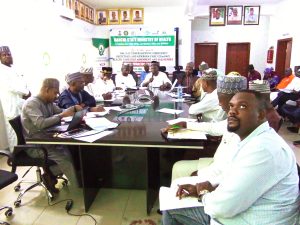
Speaking further on the SWAP intervention, representative of SWAP National Coordinating office, Dr. Ashiru Adamu Abubakar said that the CEMONC assessment exercise was a deliberate effort of the Federal Government to crash the high burden of maternal and child mortality and morbidity through having at least one functional, fully-equipped CEmONC-ready secondary facility in each of the 20 LGAs of Bauchi State.
Dr. Abubakar, who also doubles as the Technical Assistant to the Honourable Coordinating Minister of Health, said that for the State to qualify to access funding under the SWAP intervention, it has to have the minimum standard of service delivery in emergency obstetric and newborn care in terms of skilled manpower and infrastructure.

He said the assessment also provided a bill of quantity with regards to Infrastructures and architectural designs to assist the State Government in meeting the minimum requirement to qualify for the SWAP intervention.
The Technical Assistant further revealed that the findings in the assessment will provide the State with the knowledge to know it’s gaps and challenges so that they could work towards addressing such challenges.
In a goodwill message representative of JHPIEGO, Jennifer Don-Aki said that, though JHPIEGO was a technical partner in the facility assessment exercise, but that it is was the state personnel that actually went around those facilities and carried out the assessment.
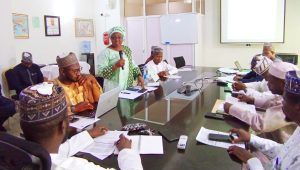
Don-Aki expressed her optimism that the findings in the assessment exercise would assist the State in strengthening CEMONC at the secondary level of care.
Receiving the assessment report, the State Commissioner of Health Dr. Sani Muhammad Dambam thanked the team for painstakingly carrying the assignment and also assured that the State will key into the SWAP initiative.
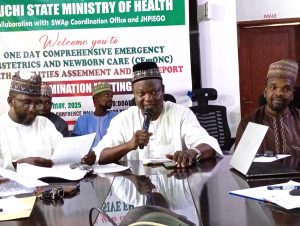
Dr. Dambam said that improved health care delivery is a top priority under the leadership of Governor Bala Mohammed and that the State will carefully study the findings in the assessment report with a view to bridging the gap highlighted so that the State can attain the requirements needed to be part of the SWAP Program.
Our Correspondent reports that the overall goal of the SWAP intervention is to strengthen comprehensive emergency obstetric and newborn care (CEMONC) services through evidence-based interventions.